Unity URP:SSR 实现
基于 URP ScriptableRendererFeature 的屏幕空间反射(Screen Space Reflection)记录采用视空间 Ray Marching + 二分求精 + 时域抖动,在
BeforeRenderingTransparents阶段计算反射后叠加到场景,支持 roughness 自适应 Mip blur、fresnel 衰减、dither 去带、Debug 视图。代码位于项目
Assets/OurFunction/SSR/,包含:SSRRenderFeature.cs、SSR.shader。
1. Introduction
Pre:ShowCase
SSR on
-
full showreel
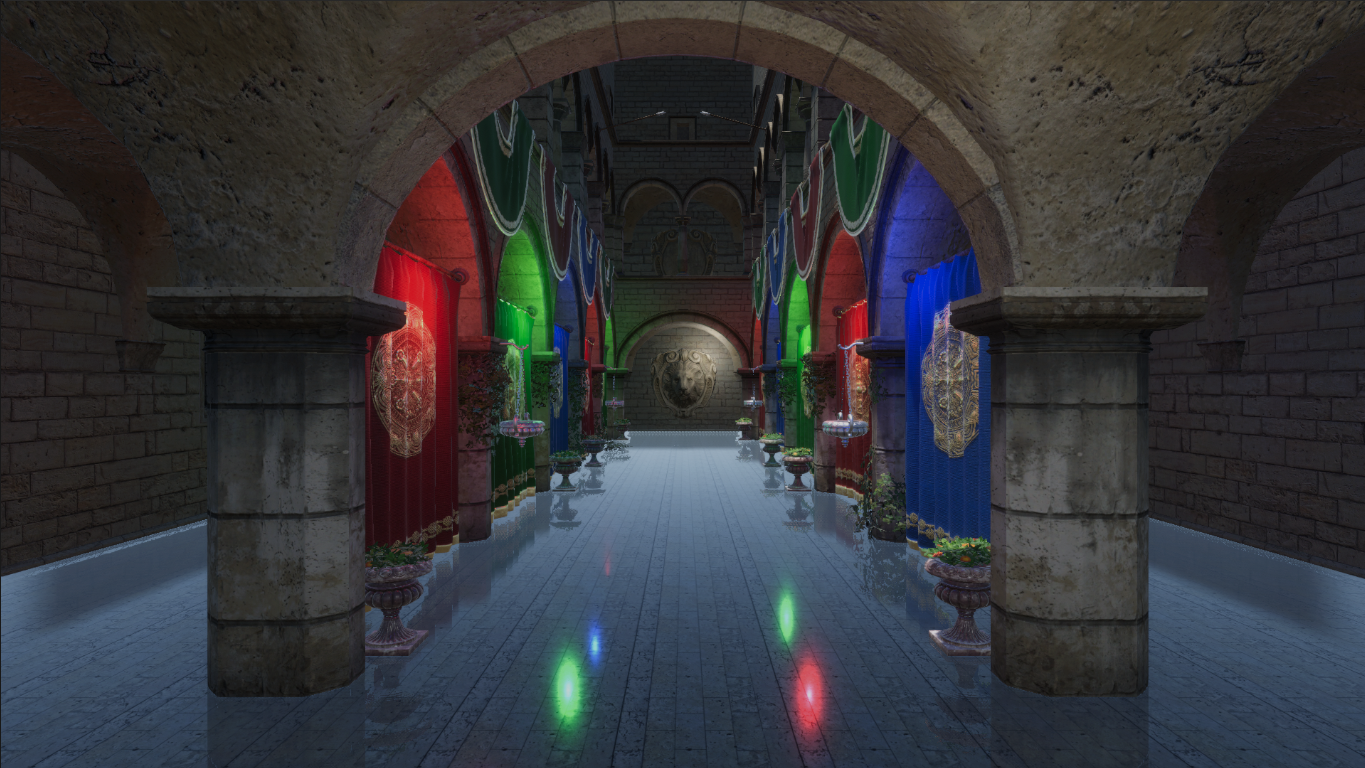
-
Hit Mask

-
Reflective color

SSR off

1.1 Why SSR?
- 第一,Reflection Probe 静态、无屏幕空间精度——probe 在预烘焙位置采样 cubemap,无法反映动态物体和近距离精确反射;
- 第二,无 SSR 则完全缺失镜面反射——光滑材质(金属、水面、玻璃)在 URP 默认管线中完全依赖 Skybox 或 probe,缺乏真实的环境反射;
- 第三,Ray Marching 的 artifact 问题——简单的前向步进容易漏过薄几何、屏幕边缘反射截断生硬、低 roughness 材质产生锯齿。
1.2 实现思路
- 核心机制:在视空间做 Ray Marching + 二分求精(Binary Refinement)——从 GBuffer 读取法线 + smoothness,计算反射方向,沿视线方向以自适应步长(
stride / sin(θ)补偿斜向步进)前向 Marching,hit 后二分 16 步精确定位交点。Composite Pass 中用 roughness 自适应 Mip level 采样反射颜色,fresnel + smoothness + ao 加权混合。 - Dither 去带:8×8 Bayer 或 Interleaved Gradient Noise(IGN)抖动反射 UV,以低步数(默认 96)覆盖连续反射面。
- 架构:
SSRRenderFeature在BeforeRenderingTransparents注入,强制开启DepthTextureMode.Depth | DepthNormals | MotionVectors。 - 2 个 Pass:
- Trace(写
_SSR_ReflectionMap,含 hit UV + mask)→ - Composite(读 GBuffer 合成反射)。
2. KeyWords
| 关键词 | 简单解释 | 具体实现 |
|---|---|---|
| View-Space Ray Marching | 在视空间沿反射方向步进,每步投影到屏幕比较深度 | FragTrace 中 使用给定Steps的 for 循环 |
| Binary Refinement | hit 后二分 16 步缩小交点误差 | BINARY_STEP_COUNT=16 逐半收缩 |
| Adaptive Stride | 斜向步长 = stride / sqrt(1 - viewReflectDot) | 补偿掠射角步长不足,向给定角度斜向marching补偿 |
| Roughness Mip Blur | 根据 smoothness 选择 Mip level 采样反射颜色 | SAMPLE_TEXTURE2D_X_LOD(_MainTex, uv, blurAmount) |
| Dither (Bayer8×8 / IGN) | 时域/空域抖动反射 UV 偏移去带 | SSR_Dither8x8 / SSR_IGN两种dithering逻辑以加大精度 |
| Fresnel | 掠射角反射更强,正面反射更弱 | fresnel = 1 - dot(viewDir, -normal) 加权反射 |
3. Technical Breakdown
3.1 视空间 Ray Marching (Pass 0: Trace)
3.1.1 反射方向计算
从 GBuffer 读取 world-space normal + smoothness,反射视线方向得 world-space 反射向量,再变换到视空间做步进:
float3 viewDir      = normalize(worldPos - _WorldSpaceCameraPos);
float3 reflectionRay = reflect(viewDir, normal);                // world-space
float3 reflectionRayVS = mul(_SSR_ViewMatrix, float4(reflectionRay, 0.0)).xyz;
reflectionRayVS.z *= -1.0;
3.1.2 自适应步长
反射方向越接近视线方向(viewReflectDot 越大),每步在屏幕空间的投影越小——固定步长会导致近垂直反射面采样不足。用 1/sqrt(1-dot²) 补偿:
float viewReflectDot        = saturate(dot(viewDir, reflectionRay));
float oneMinusViewReflectDot = sqrt(max(1.0 - viewReflectDot, 0.001));
float rayStride  = _SSR_Stride / oneMinusViewReflectDot;     // 自适应步长
float thickness  = _SSR_Stride * 2.0 / oneMinusViewReflectDot;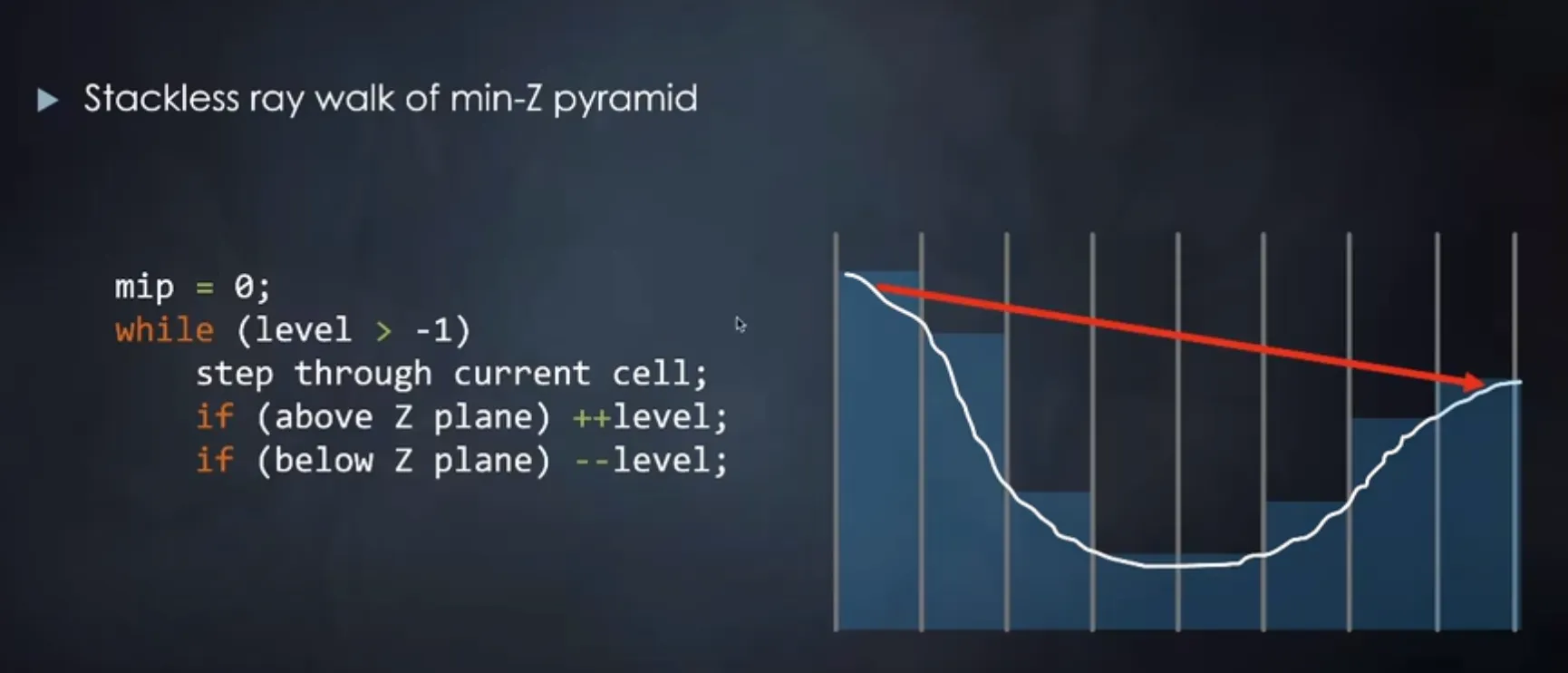
3.1.3 Marching 循环
每步将当前位置投影回屏幕 UV,比较当前视空间深度与采样深度的 LinearEyeDepth:
for (int step = 0; step < 256; ++step) {
    if (step >= actualSteps) break;
    currentPosition += ray;                                   // 步进
    float4 uv = mul(ProjectionMatrix, currentPosition);       // 投影
    uv /= uv.w;
    uv.xy = uv.xy * 0.5 + 0.5;                              // NDC→UV
    if (uv.x < 0 || uv.x >= 1 || uv.y < 0 || uv.y >= 1) break; // 出屏

    float sampledDepth = SampleSceneDepth(uv.xy);
    depthDelta = currentPosition.z - LinearEyeDepth(sampledDepth, _ZBufferParams);
    if (depthDelta > 0.0 && depthDelta < rayStride * 2.0) { hit = 1; break; }
}
hit 条件:depthDelta > 0(反射点在几何后方)且 depthDelta < rayStride*2(不是太远,防止误 hit 远处几何)。额外 depthDelta > thickness 检查排除过厚的误检。
3.1.4 二分求精
hit 后 16 步二分收敛:
for (int binaryStep = 0; binaryStep < BINARY_STEP_COUNT; ++binaryStep) {
    ray *= 0.5;
    if (depthDelta > 0.0) currentPosition -= ray;     // 前方→后退
    else                  currentPosition += ray;     // 后方→前进

    // 重新投影、比较深度
    // 若 abs(depthDelta) > 1/oneMinusViewReflectDot → 发散, 放弃
}
// 最终 backface 检测: dot(hitNormal, reflectionRay) > 0 → 背面 hit → 丢弃
3.1.5 Trace Pass 输出
// R=hitUV.x, G=hitUV.y, B=maskOut*progress, A=1.0
return half4(currentScreenSpacePosition, saturate(maskOut * progress), 1.0);maskOut:屏幕边缘 mask(SSR_ScreenEdgeMask),UV 越靠近边缘越衰减progress:smoothstep(0, 0.5, 1 - (distTraveled/maxDist)²),远处反射衰减
3.2 Dither 去带 (Pass 1: Composite)
低步数(96)Marching 在光滑面上产生明显的步进条带。Composite Pass 中对反射 UV 加抖动偏移:
// Bayer 8×8 模式: 确定型空域抖动
float dither = SSR_Dither8x8(uv * renderScale, 0.5);

// IGN 模式: 时域伪随机抖动 (Interleaved Gradient Noise)
float dither = SSR_IGN(pixelX, pixelY, frameIndex);

dither = dither * 2.0 - 1.0;                               // [-1,1]
float2 uvOffset = normalSS.xy * lerp(dither * 0.05, 0.0, stepS²);- 高 smoothness(stepS² ≈ 1):抖动压制到 0(镜面反射不需抖动,条带不明显)
- 低 smoothness:抖动最大(粗糙面需要更多采样去带)
3.3 Composite:反射合成
// 1) 反射颜色采样 (roughness 自适应 Mip blur)
float roughnessBlurAmount = lerp(0.0, 5.0, 1.0 - pow(stepS, 4.0));
float4 reflectedColor = SAMPLE_TEXTURE2D_X_LOD(_MainTex, sampler, reflectedUV, blurAmount);

// 2) 金属/非金属分离
float3 specular = lerp(float3(1,1,1), gb0.rgb, lerp(0.0, 0.6, metallic));
float3 blended  = source * (1-metallic) + reflectedColor * specular * metallic;

// 3) 反射权重 = mask * ao * fresnel * luminMask * intensity
float reflectionWeight = saturate(maskVal * ao * fresnel * luminMask * _SSR_Intensity);
result = lerp(source, blended, reflectionWeight);fresnel:1 - dot(viewDir, -normal),金属 fresnel 受gb1.x调节luminMask:pow(1 - saturate(lum-1), 5),极亮像素(光源本体)不反射ao:从 GBuffer1.y 读取,遮蔽区反射减弱
4. 执行时机与 URP 管线架构
4.1 管线插入点
═══════════════════════════════════════════════════════════════
URP 一帧

 (1) Depth PrePass → _CameraDepthTexture + DepthNormals + MotionVectors
 (2) DrawOpaqueObjects (Forward/Deferred) → cameraColorTarget
       └─ GBuffer: _GBuffer0(albedo), _GBuffer1(specular+ao), _GBuffer2(normal+smoothness)

 (3) ★ BeforeRenderingTransparents ★                       [SSR Pass]
       │  ┌─ SSRPass.Execute ─────────────────────────────┐
       │  │  1. Blit(source → TempSource)  (mipCount=8)    │  拷贝场景 (含 mip chain)
       │  │  2. Pass0 Trace:                               │
       │  │       Blit(null → _SSR_ReflectionMap)           │  低分辨率 (downsample+1)
       │  │       FragTrace 读 GBuffer2(法线+smoothness)    │
       │  │       → 视空间 Ray Marching + 二分 → hitUV+mask │
       │  │  3. Pass1 Composite:                           │
       │  │       Blit(TempSource → cameraColorTarget)      │  写回场景
       │  │       FragComposite 读 GBuffer0/1/2 +          │
       │  │       _SSR_ReflectionMap + _MainTex mip chain   │
       │  │       → roughness blur + fresnel + 混合         │
       │  │  4. 释放 ReflectionMap + TempSource             │
       │  └────────────────────────────────────────────────┘

 (4) DrawTransparents / Skybox
 (5) Post-Processing → Present
═══════════════════════════════════════════════════════════════
为什么是 BeforeRenderingTransparents: SSR 必须在 Transparents 之前完成——透明物体需要反射不透明场景的结果,同时自己不被反射(简化处理)。SSR 仅反射 Opaque 已渲染的像素。
4.2 RT 与内存
| RT | 分辨率 | 格式 | 用途 |
|---|---|---|---|
_SSR_TempSource | full², mipCount=8 | cameraTargetDescriptor | 场景拷贝 (含 mip chain 供 roughness blur) |
_SSR_ReflectionMap | full/(downsample+1) | ARGBHalf | Ray Marching 结果 (hitUV + mask) |
峰值约 2 张全分辨率 RT (~33MB 1080p)。
4.3 特殊依赖
camera.depthTextureMode |= DepthTextureMode.Depth
                         | DepthTextureMode.DepthNormals
                         | DepthTextureMode.MotionVectors;
强制开启深度+法线+运动矢量纹理,URP 在 Depth PrePass 中生成 _CameraDepthNormalsTexture(供 SSR 的屏幕空间坐标重建和 GBuffer 法线采样)。
5. 实现细节与关键代码
5.1 参数一览
| 参数 | 默认值 | 说明 |
|---|---|---|
stepStrideLength | 0.03 | 基础步长(视空间单位),越小越精确但需更多步数 |
maxSteps | 96 | 最大步数 (8-256) |
minSmoothness | 0.55 | 最小 smoothness 阈值,低于此值不计算 SSR |
intensity | 0.75 | 反射强度 |
reflectSky | false | 是否反射天空盒 |
downsample | 0 | 反射图降采样 (0=全分辨率, 1=半分辨率) |
ditherMode | InterleavedGradient | 抖动模式 (Bayer8×8 / IGN) |
6. References
- Morgan McGuire, Mike Mara. “Efficient GPU Screen-Space Ray Tracing.” Journal of Computer Graphics Techniques, 2014. — 视空间 Ray Marching + 二分求精范式。
- Chris Wyman. “An Improved Screen-Space Ray Marching Algorithm.” HPG 2016. — 自适应步长与 depth thickness 策略。
- Unity Technologies. “URP Scriptable Renderer Features / DepthTextureMode.” Unity Manual.